Beyond the Minimum:
Lessons from a Fatal Incident
This summary from a 2023 Alberta OHS investigation highlights the importance of identifying all existing and potential hazards, and of using the hierarchy of controls to eliminate or adequately control them, even when you have done that very same task before.
What Happened
In June 2023, two people (Person A and Person B) were unloading a non-running 1950’s tractor from a trailer. Important points to include are:
Both Person A and Person B had experience unloading tractors that did not run.
There was a discussion and a plan was made prior to unloading the tractor.
While the engine didn’t run, its manual steering and brakes seemed to work, and all of the tires were inflated.
The trailer ramps were set up properly for the tractor’s wheel width.
Person A stood on the tractor to steer it, and Person B used a utility tractor and a chain to pull it off the trailer. As the utility tractor moved forward, the wheels of the 1950’s tractor slipped off the ramps. When this happened, Person A fell off the 1950’s tractor. Person B stopped the utility tractor when they heard a bang and felt slack in the chain. The 1950’s tractor kept moving, striking Person A and resulting in a fatal injury. It was also identified that the front tires were misaligned, causing it to veer to one side.
Corrective Actions After the Incident
Things the employer did to prevent a similar incident from happening again:
They stopped the work and documented hazard assessments and hazard control measures for loading and unloading older model tractors.
Prevention Highlights
Employers must have written hazard assessments and control reports that:
Identify all existing and potential hazards
Identify the measures taken to eliminate or control all identified hazards following the hierarchy of control
Involve affected workers in the hazard assessment and control process
To learn more about hazard identification, assessment and control, refer to the Alberta FarmSafe Plan Manual and the free, online FarmSafe Plan Learning Program.
Incident Source: Alberta OHS Investigation file OHS-295068
2024 Agricultural Workplace Injury,
Illness & Fatality Statistics
The Government of Alberta has recently made the 2024 agricultural workplace injury, illness and fatality statistics available. Highlights to note include:
Injury Statistics
538 total injuries, with an average of just over 44 days of lost work!
15-24 year olds had the highest rate of injuries
Feedlots made the top three groups with the highest injury rates
Fatality Statistics
General farm workers suffered the highest fatality rates
Harvesting or baling – custom had the highest rates and the Poultry or egg producers had the second highest fatality rates
While injury and fatality rates are falling, it is important to note that during this time period, agriculture also saw a 22.3% decrease in its labour force (Alberta Government, 2026, p.3).
To learn more, you can view the infographic HERE.

Curious About Contractor Management on Alberta Farms?
AgSafe Alberta’s Managing Contractors on Alberta Farms: A Practical Guide will be coming soon. Check our newsletter and social media for updates!
Canadian Agricultural Safety Week Returns!
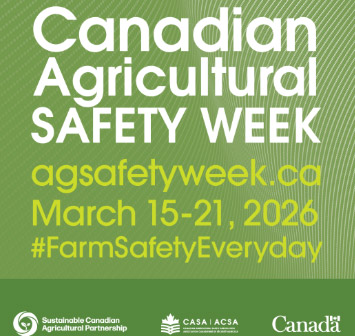
Canadian Agricultural Safety Week (CASW) is March 15 to 21 this year. This annual campaign focuses on sharing information and resources about farm health and safety.

Our Paid Courses Are FREE
Until May 31/26
That’s right, all of AgSafe Alberta’s paid courses are FREE until May 31, 2026, using Promo Code SAFESTART26!
Safety Myth of the Month
“Accidents will happen no matter what.
It’s just a part of farming.”
This is false, and a dangerous way of thinking that takes away accountability and significantly increases risk. Nearly all incidents can be prevented if the person or people performing the work have the right knowledge (e.g. hazard identification and control training, safe work practices, etc.) and put it to use. Some links to support these findings are included below:
Wildfire Prevention and Emergency Management
A little prevention and preparation can go a long way, and with a lack of snow in many areas, now is a great time to start. To help you get started, refer to Module 7: Emergency Preparedness & Management of the Alberta FarmSafe Plan Manual and use the resources below:
ROPS Safety: Preventing Fatalities from Tractor and ATV Rollovers
Tractors and all‑terrain vehicles (ATVs) are a serious safety concern on farms and for good reason. Rollovers remain one of the most common causes of fatal farming injuries. While proper load balance, a wide wheelbase and safe operator behaviour help to prevent rollovers, a rollover protective system (ROPS) is still highly effective in preventing fatalities when a rollover does occur.
What is a ROPS?
A ROPS is an engineered, strong metal frame that is firmly attached to the tractor or ATV. It’s designed and tested to meet safety standards.
What does a ROPS do?
It creates a “survival zone” that keeps the tractor or ATV from crushing the operator. The ROPS holds the machine up, and the seatbelt keeps the operator safely inside that protected space.
What’s the deal with foldable ROPS?
There are different types of ROPS, and one type people often ask about is the foldable (fold‑down) ROPS. Here are some important things to remember:
A ROPS only works when it is fully upright and the operator is wearing a seatbelt.
Before folding a ROPS down, conduct a hazard assessment and ensure it is truly necessary. If you must fold it down, then all necessary hazard control measures will need to be put in place to protect the operator and, of course, anyone else involved in the work.
Manufacturers typically advise operators not to wear a seatbelt when the ROPS is folded down. This is because, if the machine rolls over, the operator could be trapped in the seat and crushed.
Learn more about ROPS and manufacturers at Agricultural ROPS Canada (agropscanada.ca).
Safety Toolbox
This Safety Toolbox is your go-to for quick, easy access to safety tips, tools and training.
Free agricultural safety resources available in four languages from Workplace Safety & Prevention Services.
Check out this tips card for sharing the road safely with motorists, published by Iowa’s Center for Agricultural Safety and Health
Great Plains Center for Agricultural Health has developed this great infographic on air quality & gas exposures on farms.