Beyond the Minimum:
Tragedy Narrowly Avoided on a Public Road
This summary is based on an incident that occurred earlier this summer in Ontario. While it happened outside Alberta, the situation will feel familiar to many Alberta farmers, including the author.
What Happened
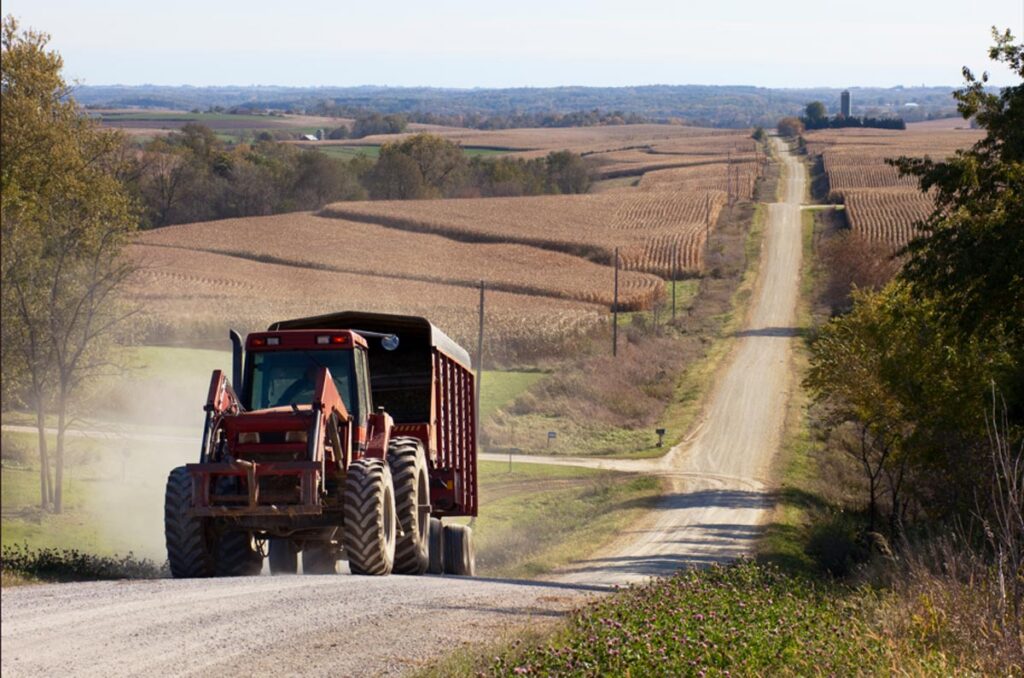
For one sixth-generation farmer, a routine morning on the farm turned into a life-threatening collision. He woke up early, climbed into his tractor shortly after 4:30 a.m., turned on the lights and drove down the road to his dairy barn, less than a kilometre away, to milk his cows. On this particular morning, he had a disc bine attached to the tractor.
About halfway to the barn, the farmer noticed a transport truck approaching from behind. He was not surprised, as traffic on that road had increased significantly over the years. However, he quickly realized that the transport truck was not pulling over to pass, nor was it slowing down.
The transport truck hit the tractor, destroying the disc bine and tearing the axle from the tractor. Although injured, the farmer was able to exit the tractor through the rear window. The extent of his injuries was not reported.
The farmer reported that the driver of the transport truck appeared uninjured, and noted that he did not see skid marks nor any other sign that the transport truck had tried to stop. It was reported that the driver of the transport truck was charged with careless driving under the Highway Traffic Act.
In an interview with CBC Ottawa, the farmer described how his family experiences “close calls” almost daily. He said excessive speeds, often well above the posted limit, are regularly observed on the road, and noted that his father has even installed a dash cam in his tractor.
Source: CBC News: Farmer feels lucky to be alive…
Things You Can Do
Farmers cannot control how other motorists behave, but there are steps you can take to improve the safety of your farm team, increase awareness of farm equipment on public roads and help address recurring road-safety concerns in your area.
Make farm equipment as visible as possible.
Take every reasonable step to make farm equipment visible to other road users and to reduce the chance of a serious incident.
This includes always doing what you can to ensure travel on public roads is as safe as possible for your farm team, such as:
Keeping your lights, mirrors, windows and slow-moving signs clean and unobstructed.
Where permitted, placing bright, temporary sandwich boards at key locations along the road to notify approaching drivers of certain farm activities.
If necessary, using escort vehicles (e.g., during an oversized equipment move). For more information on how to do this properly, refer to the Government of Alberta’s Escort Vehicle Operator’s Handbook.
Speak with your local peace officers and/or RCMP to see if increased patrols are available in areas and during times when concerns are most likely to occur.
Work with your local community.
If dangerous driving around farm equipment is a regular problem, don’t assume that reporting a single incident will be enough to address it.
Talk to your local peace officers, RCMP, municipal administration and elected municipal representatives about these issues and your concerns.
Encourage other farmers in your area to document and report similar issues. A record of multiple incidents, locations, dates and times can help demonstrate that there is a real problem and may help authorities or governing bodies determine where additional enforcement or other measures are needed.
Attend municipal council meetings or other appropriate public meetings when necessary to raise persistent road-safety concerns.
Report dangerous driving to authorities.
Important: Do not attempt to obtain driver information by pursuing, confronting or otherwise engaging with an unsafe driver.
When another driver’s actions place people at immediate risk and can be thought of as emergencies in progress, call 9-1-1.
For things that have already happened (e.g., a farm team member tells you about something that happened the previous day), call the administrative line of your local RCMP detachment.
Under Alberta OHS legislation, company vehicles are considered work sites. You can report company vehicles directly to Alberta OHS:
Immediate dangers may be called in to 780-415-8690.
For non-urgent situations, you can report your concern online: File an OHS Complaint
Install cameras on equipment.
Consider installing forward- and rear-facing dash cameras on farm vehicles and equipment that regularly travel on public roads. If an incident occurs, whether it results in damage, injury or a near miss, save the footage and record the details as soon as it is safe to do so.
Save the footage rather than allowing it to be overwritten.
Record the date, time and location of the incident. If you are able and it is safe to do so, record other relevant information such as the vehicle description, company name or licence plate.
Provide footage to police or other appropriate authorities when it may assist an investigation.
Keep records!
Keep a record of road-safety incidents. Things to record include:
The date, time and location
What happened
Who was involved, if known
Any available photographs or video
Who the incident was reported to
When it was reported
What response was received
Any subsequent follow-up
The primary purpose of documenting these incidents is to help identify recurring problems and encourage appropriate action. A well-maintained record may also help demonstrate whether measures taken by authorities or other organizations are working or if more needs to be done.
This type of documentation may also be useful if further investigation, regulatory action or legal proceedings become necessary.
#ShareForFarmSafety
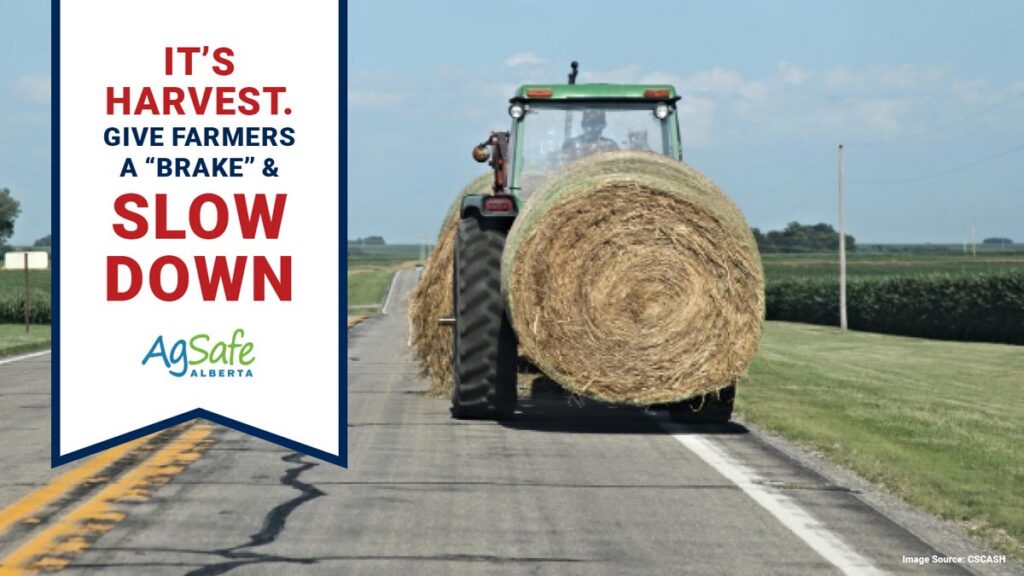
Social media is a powerful way to help spread important farm safety messages, especially during busy seasons like harvest.
By liking, commenting on and sharing AgSafe Alberta’s posts, you can help ensure critical information reaches more farmers, ranchers, workers, rural residents and, in this month’s case, drivers. A single share can help remind someone to slow down near farm equipment, stay alert for slow-moving vehicles or make safer choices on rural roads during one of the busiest times of the year.
As harvest gets underway across many parts of Alberta, rural roads see increased traffic from agricultural equipment, trucks, school buses and commuters. Sharing farm safety content helps raise awareness of the unique hazards that exist during this season and encourages everyone to do their part to keep roads safe. Whether you’re a producer, worker, industry partner or community member, your support can help amplify these important messages and contribute to a safer harvest season for everyone
CASH Ag Injuries & Fatalities
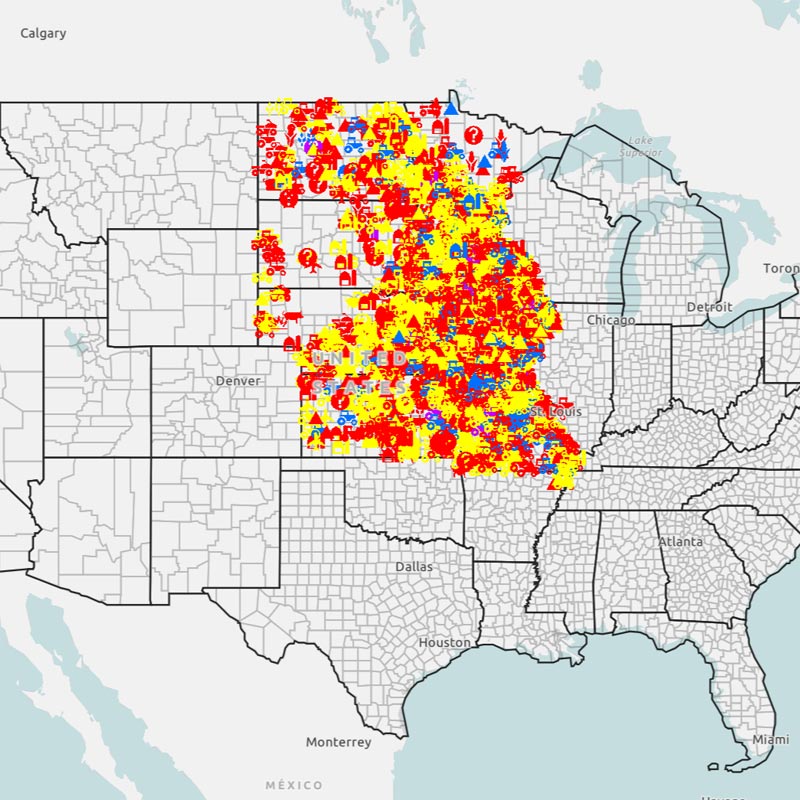
Central States Map
Farming practices do not change dramatically from one country to the next. Our neighbours to the south can offer useful insights into agricultural injuries and fatalities, including where certain types of incidents are being reported. Click the link below to explore the map and see what patterns stand out.

Need Safety Help on Your Farm?
AgSafe Alberta advisors understand agriculture and will use their experience and knowledge to support you in making your farm safer. Qualifying farms can get up to 10 hours of FREE advisor support!
Safety Myth of the Month
“I’ve been doing it this way for over 40 years
and I’m still here, so I must be doing it safely.”
Experience can build confidence, but it does not eliminate risk. Canadian Agriculture Injury Reporting data shows that 65% of farm fatalities between 2011 and 2020 involved people over the age of 50.
As we age, factors such as reduced strength, slower reaction times, fatigue, hearing or vision changes, medical conditions and medications can increase the consequences of unsafe practices that may have gone unchallenged for years.
Safety can be made simple at any age. That is why AgSafe Alberta created the FARMERS CARE program: to provide a practical, easy way for producers of all ages to improve safety on their operations.
All four levels are free when taken in sequence, and each completed level provides a personalized certificate of completion. So, what does the FARMERS CARE program cover?
Level 1 introduces hazard identification and farm safety fundamentals.
Level 2 focuses on training, orientation and communication, all of which are critical to managing hazards and risks on family farms and farms with employees.
Level 3 covers basic inspections that will help you identify issues and fix them before they become bigger problems.
Level 4 covers emergency preparedness and management basics. It helps you identify the things you can do in advance and how to better navigate emergencies.
Get started today at agsafeabseed.ca!
Farming & Growing Older
Imagine having an older tractor on your farm; it is versatile, easy to repair, doesn’t have payments and you have been using it for nearly 30 years. Due to its age, it doesn’t have a lot of safety features and your father used to start it from the ground because he found it difficult to climb up and down from the seat. You start that tractor the same way. At first were following his example, then it became a habit, and now old injuries and arthritis make it difficult for you to climb up and down out of the seat.
It’s time to get the hay up. Normally, your spouse would help you, but they had a surgery not long ago and can’t help this season. To make matters worse, your newer tractor with all the bells and whistles developed an electrical issue that you can’t seem to fix, so you have been using your old tractor instead. After spending many long, hot hours in the field the day before, you go out early in the morning to start up “old reliable,” but because you were so tired last night, you forgot to take it out of gear and didn’t set the parking brake.
You turn the key. The tractor lurches forward, knocking you to the ground and…
As we get older, unsafe practices combined with age-related factors such as hearing loss, vision loss, slower reaction times, reduced sleep quality, reduced muscle strength, medical conditions and medications can increase our likelihood of a serious injury or fatality while working on the farm. What we may have been able to get away with doing before (by sheer luck or chance), we are less likely to over time.
This does not mean that older farmers need to or should stop farming. What it means is that we need to be even more safety conscious as we age and take all these factors into consideration before doing something.
It is as simple as taking a moment to answer these questions:
How often do you do things that are unsafe/could be done more safely?
What conditions, medications, illnesses, stressors or other factors could impact your ability to get the work done safely?
What could go wrong when you do these things?
How severe would the consequences (outcomes) be if something did go wrong?
What can I do to make it safer and prevent something from going wrong?
What can you do? Start with one simple step: take the free, online FARMERS CARE program, get a copy of the free FARMERS CARE booklet or sign up for AgSafe Alberta’s monthly newsletter. Small improvements can make daily farm work safer, especially when they help you spot habits that may have become riskier over time.
Are You Risk Blind?
Farming commonly involves high-risk work. One of the problems is that so many people living and working on farms have become blind to the risks they face every day. In an article titled “The Risk of Risk Blindness” published by Integrity Governance®, an organization that works with companies worldwide to better manage their businesses, six factors that contribute to risk blindness are identified:
Recency: Greater energy and attention are often given to events that have happened recently, rather than on the probability of risk.
Visibility: Humans tend to focus on the things that we can see over the things that we cannot see.
Assumptions: Too many decisions are made because people make assumptions about risk.
Too much or too little confidence: Too much confidence results in people ignoring certain risks, whereas too little confidence results in overestimating the impact of some risks.
Skills: People simply do not know what they do not know; this results in not being aware of the risks that they are taking.
Culture: The way a farm talks about safety, responds to shortcuts and handles close calls can shape what workers and family members see as acceptable risk-taking behaviour.
(Integrity Governance®, n.d.)
This is where what the farm considers to be acceptable risk-taking behaviour becomes clear (what is acceptable to do and what is not).
Take a moment to remind yourself of common farm hazards and what they can result in using the FARMERS CARE booklet. You can also learn more about identifying hazards and managing risk on your farm in the Alberta FarmSafe Plan Manual and free, online Alberta FarmSafe Plan Learning Program.
Safety Toolbox
This Safety Toolbox is your go-to for quick, easy access to safety tips, tools and training.
When was the last time you visited the AgSafe Alberta Store? Check it out today and see if there is anything you can use on your farm!
Check out this recent podcast from Talking Total Farmer Health: First Responders and Farm Emergencies!
WorkSafe New Zealand discovered some interesting things following assessments on 680 farms, the majority of which had fewer than five workers! Read more here: Hidden hazard: farm safety exposes substances risk gap.
Farm safety is all about practical, good-sense prevention. Take a moment to read this article from North Dakota State University: Reduce risk of combine fires with regular preventative maintenance.