OHS in Practice:
What a Recent Alberta Farm Court Case Tells Us
This article is intended to bring attention to how OHS legislation is being applied to farming and ranching operations only.
What Happened
In March of 2023, a farm worker was dumping gravel on a road approach to a field when the box of the truck contacted an overhead power line. The worker was standing outside the vehicle at the time, operating the controls to raise the box. The worker was fatally injured.
What the Farm was Charged With
The farm was charged with the following seven counts under the Alberta Occupational Health and Safety (OHS) Act:
Section 3(1)(a)(i) of the OHS Act: Failure to ensure the health and safety of a worker engaged in the work of that employer who was electrocuted while operating an end dump trailer box near an overhead power line.
Section 3(1)(a)(i) of the OHS Act: Failure to ensure the health and safety of their worker by failing to establish, implement and enforce a safe work procedure for operating equipment near an overhead power line.
Section 3(1)(a)(i) of the OHS Act: Failure to ensure the health and safety of their worker by failing to ensure the worker maintained a safe distance between an end dump trailer box and an overhead power line.
Section 3(1)(a)(i) of the OHS Act: Failure to ensure the health and safety of their worker by failing to provide the worker with a spotter while the worker was raising an end dump trailer box near an overhead power line.
Section 3(1)(a)(i) of the OHS Act: Failure to ensure the health and safety of their worker by failing to ensure the worker followed the operator’s manual for the end dump trailer, in which an operator must ensure that overhead clearance is adequate before hoisting an end dump trailer box.
Section 3(1)(a)(i) of the OHS Act: Failure to ensure the health and safety of their worker by failing to ensure the worker complied with section 4(1)(c)(iii) of the Commercial Vehicle Dimension and Weight Regulation.
Section 3(1)(a)(i) of the OHS Act: Failure to ensure the health and safety of their worker by failing to comply with section 4(1)(c)(iii) of the Commercial Vehicle Dimension and Weight Regulation.
These charges accused the farm of a failure to take reasonable steps, which are requirements under the OHS Code, such as those listed in Part 2 Hazard Assessment, Elimination, and Control, and Part 17 Safe limit of approach distances. Although the defence lawyer successfully argued the case, it still took three days in a courtroom, and a number of pre-trial applications, before the charges were withdrawn. More details about this case are publicly available on the Government of Alberta’s 2026 Prosecution outcomes and appeal status page.
Important Takeaways
This case highlights that the OHS Code is made up of basic, reasonable steps, and that farms are still expected to take those steps — even when the OHS Code does not directly apply to them.
When it comes to anything related to law, definitions matter. The OHS Act does not define what basic safety standards are, nor is the author aware of anyone receiving a clear written explanation as to what Alberta OHS considers “basic standards” to be.
Both the OHS Act and OHS Code provide “minimum standards” for health, safety, and wellness in Alberta’s workplaces. These minimum standards” put in place the most basic, reasonable steps an employer would need to take to protect the health and safety of their workers and are the result of many years of consultations between industry, education and research groups, and the government.
Employers are responsible for ensuring the health, safety and welfare of the workers engaged in their work as far as reasonably practicable (Alberta OHS Act, S3(1)). In some cases, even the minimum laid out in the OHS Code may not reflect what is reasonably practicable for the employer, the work and/or the circumstances.
It is critical that the farm completes and documents its own well‑thought‑out hazard assessments and does not rely on generic templates from outside organizations. When done properly (i.e., it identifies all of the unsafe or dangerous conditions, including those that could be expected to develop, and appropriate hazard control measures are put in place), injuries and fatalities are prevented, and the farm can show that it did everything reasonably expected of it.
If an OHS Officer comes to the farm following a serious incident and performs their own hazard assessment, they will identify any unsafe or dangerous conditions, as well as what was or was not done to control the conditions. If the OHS Officer finds that the farm did not identify a hazardous condition it reasonably should have or did not take the necessary steps to control the hazardous condition, the farm can expect enforcement actions, some of which can have serious consequences.
Get working on your farm’s safety program with the help of AgSafe Alberta. We offer many free, online tools and resources on our website, and also provide up to 10 hours of free, on-farm support to qualifying farms. To learn more, visit agsafeab.ca, refer to the Alberta FarmSafe Plan Manual and the free, online FarmSafe Plan Learning Program.
April 28 is the National Day of Mourning
The National Day of Mourning is a day to remember and honour those lives lost or injured due to a work-related incident. It’s also time to renew our commitment to improving health and to preventing further injuries, illnesses and deaths.
Need Safety Help on Your Farm?
AgSafe Alberta Advisors understand agriculture and will use their experience and knowledge to support you in making your farm safer. Qualifying farms can get up to 10 hours of FREE advisor support!

Our Paid Courses Are FREE
Until May 31/26
Keep your money where it belongs. All of AgSafe Alberta’s paid courses are FREE until May 31, 2026, using promo code SAFESTART26!
FARMERS CARE Review #1 Is Here!
Are you ready for a quick farm safety refresher?
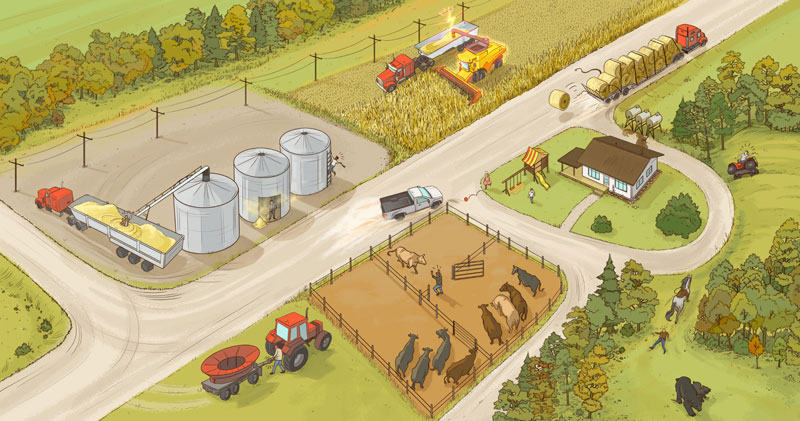
The FARMERS CARE Review #1 is a short (about 15-minute) interactive review to help you get back into the safety mindset. In this mini‑course, you’ll spot what’s going wrong on Fast Freddy’s Farm and explore practical, real‑world ways to prevent problems before they happen.
It’s also a great way to learn together. Invite your parents, kids, friends or coworkers to take it too!
Get your safety eyes on and try it today! Click HERE to get started.
Safety Myth of the Month
“I’m safe. I wear PPE, it’s all I need.”
Personal protective equipment (PPE) is considered the last line of defence and is the least effective measure you can take. Why?
PPE does not control or remove the hazard. The danger is still there.
PPE is hazard-specific. For example, the right respirator and cartridge must be used for specific respiratory hazards, and the right type of glove made from the right material will be needed to protect against certain chemicals.
PPE also requires various degrees of training; for example, a respirator will involve a fair amount of training (including a fit test) to protect effectively.
PPE depends on the behaviour of the person wearing it. Are they always using it when they should? Are they caring for it and handling it the right way?
PPE does not protect others.
Remember, PPE is your last line of defence and should only ever be used in combination with other, more effective hazard control measures, such as guards, training, safe work procedures, etc. To learn more about PPE and other hazard control measures, check out the Alberta FarmSafe Plan Manual.
Safety Toolbox
This Safety Toolbox is your go-to for quick, easy access to safety tips, tools and training.
- Understanding animal behaviour, particularly during calving season, is critical. Take a moment to read this resource from WorkSafe BC that contains helpful safe work practices: Farmhand dies after being charged by cow.
- Farm work is loud, but how loud is too loud? Hearing loss among adult farmers is nearly double that of non-farmers, yet it is 100% preventable. In this episode of the Farm Safety Roundup, RealAg’s Shaun Haney talks with Scott McLachlin, Specialized Consultant, Occupational Hygiene, with Workplace Safety & Prevention Services, to unpack what that really means on today’s farms.” Listen in to Episode 17: Noise – How Loud is Too Loud now.
- Check out this infographic resource from the Agricultural Health & Safety Network called Farm Safety Facts: Drowning & Dugouts